
Katana
Your scanner found 847 vulnerabilities.
Katana tells you which ones are actually costing you moneyand estimate how much.
Katana is a security intelligence platform that connects vulnerability findings to live infrastructure telemetry, then uses AI to estimate the dollar impact of unresolved issues. Not severity labels. Not CVSS scores. Estimates your CTO can act on.
Be first in line when we open the doors. No spam, ever.
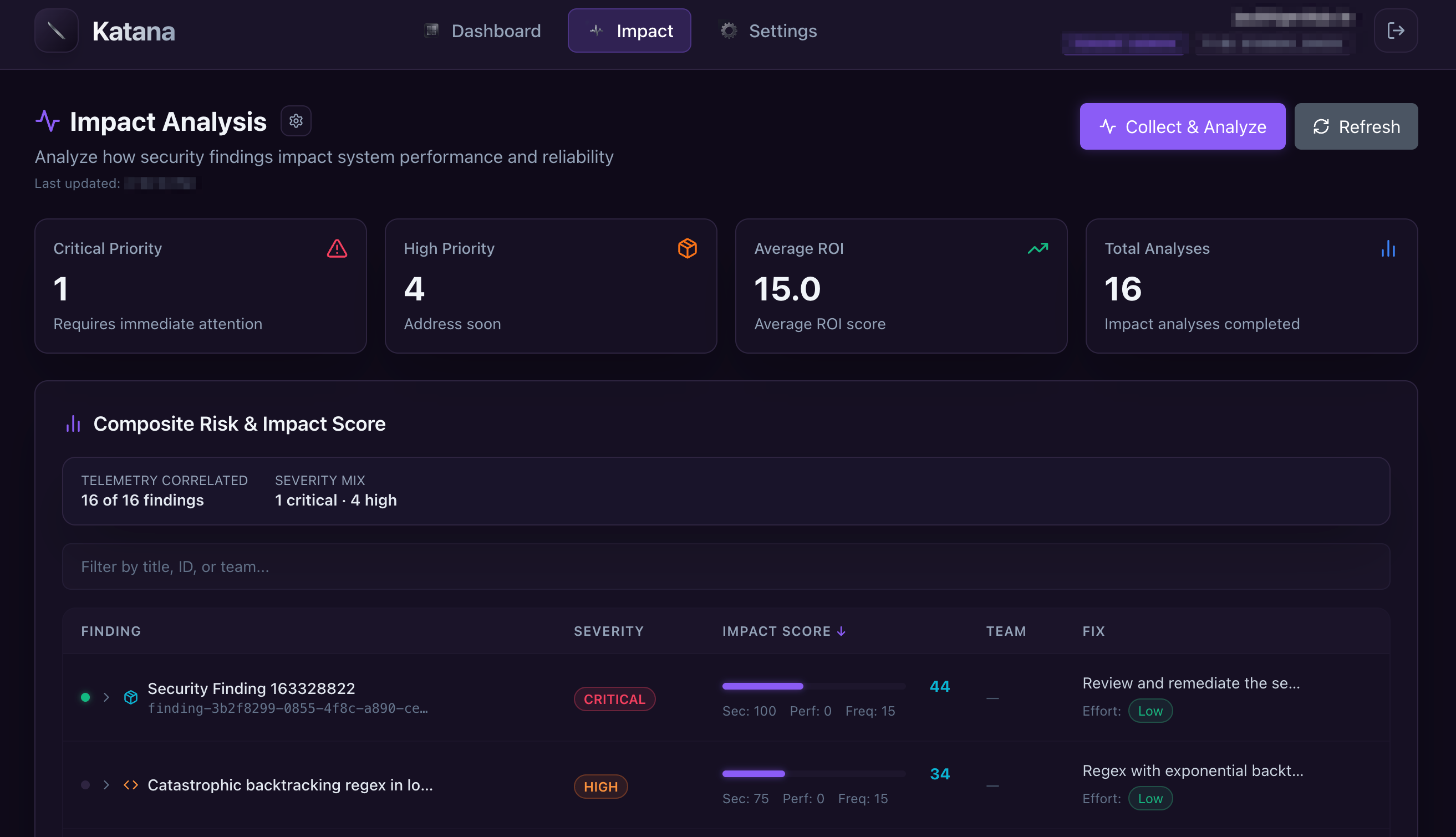
Internal testing: findings correlated to the exact cloud resource running the affected code
Every engineering team has this
conversation on repeat.
The scanner produces a list. 150 items. CRITICAL at the top. The security lead says fix it first. The engineering lead says we're mid-launch, it hasn't been exploited. The CTO asks: what does it cost to fix versus cost if we leave it? Nobody has a number. The ticket goes to the backlog.
Three months later, the same conversation. The same backlog.
Security tools have gotten very good at finding vulnerabilities.
None of them have solved prioritisation with financial accountability.
The four questions every competitor stops before asking
“What is this vulnerability costing me right now?”
Katana connects each finding to the cloud resource running the affected code. It pulls live performance metrics (error rates, latency, CPU) and estimates what degraded performance may be costing in compute waste and customer-facing impact. The output is a dollar figure per month, not a severity label.
In internal testing, Katana surfaced five- and six-figure estimated monthly costs of inaction that severity-only tools miss.
“Who introduced this vulnerability, and when?”
Katana traces from live infrastructure data back through the codebase to the exact commit SHA, author, and message. Anonymous backlog items become named, accountable engineering actions.
Commit attribution pipeline is built. Active SCM integration per customer is the next milestone.
“What should I fix first, and why?”
Katana feeds the full context (finding details, live telemetry, dollar impact, commit attribution) into AI. Output: a prioritisation score, cost-of-inaction per month, numbered remediation steps with actual code diffs specific to your infrastructure.
A prioritization score, a monthly cost-of-inaction estimate, and numbered remediation steps with code diffs specific to the named function.
“Did the fix actually work?”
After remediation, Katana captures actual outcomes — hours spent, realised savings — and compares them against the AI estimate. This creates a feedback loop that improves future predictions and gives leadership evidence that the security programme generates measurable returns.
Regex backtracking fix: latency 4,820ms → 310ms (↓94%). Break-even: 8 days.
Everything your security team has been missing
Dollar-Denominated Risk
CVSS scores tell you severity. Katana is designed to tell you cost. Findings are ranked by estimated monthly dollar impact, drawn from live infrastructure telemetry rather than modeled assumptions, so a security backlog reads as a budget line, not just a priority label.
Unified Security Intelligence
Stop context-switching between scanners, dashboards, and spreadsheets. Katana ingests findings from your existing security scanners, correlates them against live infrastructure telemetry, and surfaces everything in a single prioritised view.
Finding-to-Resource Correlation
Katana correlates findings to the exact cloud resource running the affected code, with live performance deltas attached. Finding-to-resource correlation with live telemetry provides context no static scanner can produce.
AI-Driven Remediation
Katana feeds finding details, live telemetry, and dollar impact into AI. The output: a prioritisation score out of 100, cost-of-inaction per month, numbered remediation steps with actual code diffs — specific to your function, your service, your stack.
Commit Attribution
Katana traces from live infrastructure data back through the codebase to the exact commit SHA, author, and message that introduced the vulnerability. Anonymous backlog items become named, accountable engineering actions.
Read-Only. No Agents.
Katana takes a read-only role in your cloud environment. No agents to deploy, no code changes, and no access to customer data, only infrastructure performance metadata.
Performance outcomes we measured in testing
Measured improvements after Katana-identified vulnerabilities were remediated in a live AWS environment. Results will vary based on your infrastructure, traffic patterns, and finding characteristics.
| Latency reduction (regex fix) | 4,820ms → 310ms ↓94% |
| Error rate reduction | 3.40% → 0.30% ↓91% |
| CPU reduction | 97% → 22% ↓77% |
| Finding-to-resource correlation | Achieved |
| AI analysis time | ~24 seconds per finding |
Metrics shown are illustrative, derived from internal testing on a single demo environment.
Built for teams that ship to the cloud
CTO / VP Engineering
Running production workloads in the cloud with 5-200 engineers and a security backlog you can't prioritise. You're asked by the board to demonstrate security ROI. Katana gives you the answer in dollars.
CISO / Head of Security
You need to communicate security investment in financial terms to non-technical leadership. Katana gives you a portfolio narrative and a dollar-denominated remediation queue - not a list of CVEs.
Senior Engineer / DevSecOps
Tired of arbitrary prioritisation and want to make the case for fixing things with data. Katana gives you the numbers to win that argument and the remediation steps to close it.
We're almost ready
Be first to wield it.
Early access spots are limited. The intersection of security findings, infrastructure telemetry, and AI reasoning is currently unoccupied. We're about to change that.